


Fireworks Don’t Work for Wildlife, Pets, or People

By Mallorie Harbour and YEA Team
The Fourth of July is a time to celebrate American independence with family, friends, and community traditions. For millions of people, however—and for countless pets and wildlife species—it is anything but a celebration.
Behind the bright colors and excitement is an often-overlooked form of environmental pollution: noise pollution.

What is Noise Pollution?
Noise pollution is defined as unwanted or harmful sound that disrupts normal life and natural ecosystems. Most of us associate it with highways, airplanes, construction sites, gas-powered landscaping equipment, and industrial activity. Yet one of the loudest and most widespread sources of noise pollution each year comes from a single holiday: Independence Day.
While fireworks last only seconds, their impacts can linger for hours, days, and even years.
The Hidden Health Effects of Fireworks
Sound is measured in decibels (dB). A quiet library measures around 40 dB, normal conversation is approximately 60 dB, and a lawn mower averages around 90 dB.
Experts warn that prolonged exposure to sounds above 85 dB can damage hearing, while sounds above 140 dB can cause immediate hearing injury. Consumer fireworks routinely reach 150 dB or more, making them comparable to gunfire or jet engines at close range.
Unlike other loud sounds, fireworks are unpredictable. The sudden explosive bursts make it difficult for our brains and bodies to prepare, increasing stress and anxiety while creating a greater risk of hearing damage for both adults and children.
Fireworks and PTSD
For many veterans, first responders, survivors of violence, refugees, and others living with Post-Traumatic Stress Disorder (PTSD), fireworks can trigger intense emotional and physical reactions.
The booming sounds closely resemble explosions and gunfire, causing increased heart rate, anxiety, flashbacks, panic attacks, and sleep disruption. While many people with PTSD develop coping strategies, those strategies become much more difficult when fireworks begin days before July 4 and continue late into the night or early morning hours.
Respecting our neighbors by limiting unnecessary fireworks is a simple act of community care.

Our Pets Hear More Than We Do
If you've ever watched a dog pace, shake, hide under furniture, or desperately search for a safe place during fireworks, you've witnessed the effects of extreme stress.
Dogs and cats hear a much wider range of frequencies than humans and are far more sensitive to loud sounds. Fireworks can cause:
Rapid heart rate and heavy panting
Trembling and anxiety
Attempts to escape homes or yards
Hearing damage
Long-term fear responses
Animal shelters across the United States consistently report that July 5 is one of their busiest days of the year, with a significant increase in lost pets following Independence Day celebrations. Studies also show missing pet reports increase by approximately 30% during July 4 fireworks celebrations.
Even pets that have never shown fear before can panic unexpectedly.
Wildlife Pays the Price
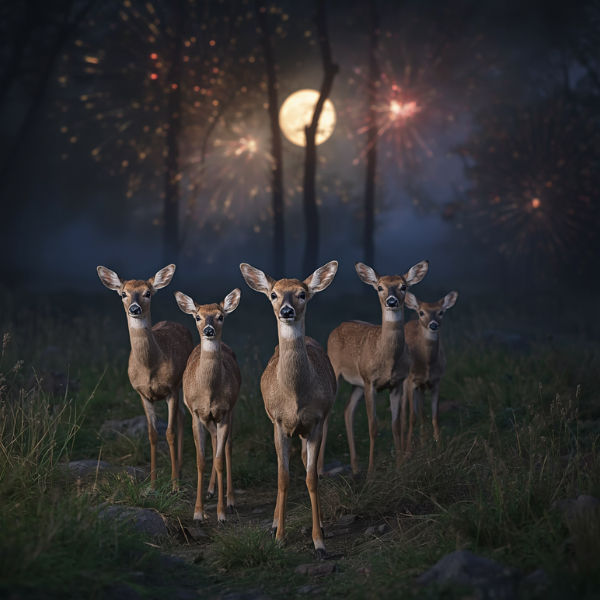
Wildlife cannot understand that fireworks are temporary celebrations. Instead, they interpret the sudden flashes and explosions as immediate danger.
Birds sleeping in trees or marshes often take flight in complete darkness, where poor night vision increases the likelihood of collisions with buildings, power lines, and trees. In one well-known incident in Arkansas, approximately 5,000 red-winged blackbirds died after becoming disoriented and colliding with obstacles following fireworks explosions.
Shorebirds may abandon nests, leaving eggs and chicks vulnerable to predators and heat. Deer, foxes, raccoons, turtles, and other wildlife can flee into roadways, increasing vehicle collisions.
Noise pollution also interferes with one of nature's most important survival tools: communication.
Birds rely on songs to defend territory and attract mates. Frogs call to reproduce. Insects communicate through vibrations and sound. Predators listen for prey while prey listen for approaching danger.
When fireworks drown out these natural signals, animals lose the ability to communicate, navigate, avoid predators, and find one another.
A Better Way to Celebrate
Celebrating our nation's independence doesn't have to come at the expense of our communities and ecosystems.
Here are a few simple ways to make the holiday more wildlife-friendly:
Attend a community event.
Rather than multiple backyard displays, enjoy one professionally managed show that limits the overall amount of noise and air pollution.
Choose low-noise fireworks.
Many manufacturers now produce colorful fountains, comets, and other "quiet fireworks" that emphasize visual effects instead of explosive booms.
Keep celebrations short.
Ending fireworks by 9:00 p.m. and limiting them to July 4 helps reduce prolonged stress for people, pets, and wildlife.
Protect your pets.
Keep pets indoors before sunset.
Close windows and curtains.
Turn on a fan, television, or calming music for background noise.
Make sure collars and microchip information are current.
Never bring pets to fireworks displays.
Consider new traditions.
Drone light shows, laser displays, lantern walks, concerts, and community festivals create memorable experiences without the harmful impacts of excessive noise.
Freedom Includes Caring for Our Communities
The Fourth of July is an opportunity to celebrate the values that bring us together. By choosing thoughtful ways to celebrate, we can honor our nation's independence while protecting veterans, children with sensory sensitivities, families, pets, and the wildlife that share our neighborhoods.
A beautiful celebration doesn't have to be the loudest one.
Follow YEA on Facebook and Instagram or sign up for our newsletter at www.YouthEnvironmentalAlliance.com.


Comments